
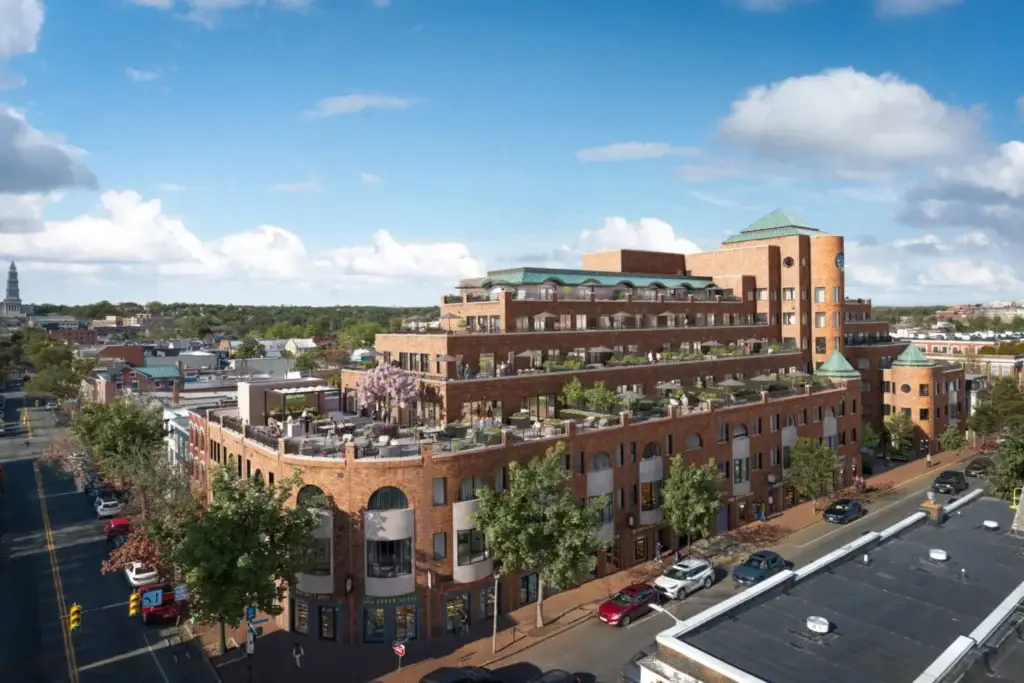
Alexandria Office to Residential Conversion
The morning headlines keep coming, each one sounding like a real estate revolution: another vacant office building in Alexandria transforming into hundreds of new apartments or hotel space. CityHouse Old Town. TideLock. 801 North (everyone knows it as the former offices of AAA). The Herron Hotel. What started as a trickle has become a torrent—over 3.7 million square feet of office space either approved for conversion or already transformed into residential units over the past decade. And with the city’s office vacancy rate climbing from 15% in 2023 to over 23% in 2025, we should all be celebrating this adaptive reuse success story but there is a little more to it.
But here’s where it gets complicated, and as someone who’s watched Alexandria’s commercial real estate market evolve for more than two decades, I can tell you that what looks like a simple solution will have downstream impacts.
The National Context: We’re Not Alone
Let me put Alexandria’s situation in perspective. We’re experiencing something that’s happening across virtually every major American city. According to recent data from RentCafe, the national office-to-residential conversion pipeline hit a record-breaking 70,700 apartment units in 2025, up from just 23,100 units in 2022. Office conversions now account for 42% of all adaptive reuse projects nationwide.
The numbers tell a stark story: the national office vacancy rate stands at nearly 20%, with some markets pushing past that threshold. In our region, Northern Virginia’s overall vacancy sits at 23.1%, though Alexandria is now below 20%, partly due to the conversions to residential. But we’re hardly immune—CommercialCafe reports Alexandria’s office vacancy at 30.24% overall for 2024, with some submarkets like the Eisenhower Avenue Corridor hitting 33%. Cities from Washington, D.C. (which led the nation with 5,820 converted units from 2021-2024) to New York, Dallas, and Los Angeles are all racing to repurpose obsolete office space. The difference? Most of them started as bedroom communities. Alexandria didn’t.
The Historical Stakes: More Than Just Empty Buildings
Before the 1980s, Alexandria was primarily a bedroom community for Washington, D.C. People lived here, slept here, but earned their paychecks elsewhere. Then a wave of associations, non-profits, and professional services firms through a concentrated development and recruitment plan by the City of Alexandria that offered something special—a walkable, historic city with character, proximity to D.C., and lower rents than Arlington to incubate start-ups and mom and pop businesses. The Patent and Trademark Office. Trade associations. Law firms. Architectural practices. These weren’t just tenants filling buildings; they were employers creating an economic ecosystem that made Alexandria more than just a place to sleep between commutes. That transformation took forty years to build. It can unravel much faster.
The Hard Math of Conversion
I’ve walked through dozens of these older office buildings with clients over the years. The Victory Center—600,000 square feet vacant for 21 years—is a perfect case study. Built in 1973 for the Army Material Command, it’s been chasing federal tenants ever since they left in 2003. Despite two owners, multiple incentives from the city, and countless proposals, nobody wanted it as office space. The conversion that City Council approved in December will create 377 residential units, 82 of them at various levels of affordability. Developer Stonebridge is getting a 25-year partial tax abatement—90% in the first five years, stepping down gradually—to make the economics work. Without those incentives, the building would likely continue sitting empty, contributing roughly 3% of the city’s total office vacancy.
Here’s the economic reality that most people don’t understand: these conversions are expensive and complex. According to industry experts at Gensler, fewer than 20% of office buildings are ideal conversion candidates. Floor plates need to be right. Buildings need functioning windows and adequate natural light. The bones need to support residential life, not just cubicle farms. Many conversions require public subsidies to pencil out financially. CityHouse Old Town, the 199-unit luxury conversion at 1101 King Street, is now leasing units from $2,550 for a studio to over $11,000 for a three-bedroom. The building, formerly a mostly vacant 1980s office, has been completely reimagined with a six-story interior atrium and panoramic views. But here’s the question: are we trading employers for residents?
The Tax Revenue Mirage
City officials often point to increased tax revenue from residential conversions. And yes, on paper, Alexandria’s residential tax base has outpaced its commercial base—residential grew 3% in recent years while office property values dropped 12.38%. But that’s only half the story. Residential development costs the city far more to service than commercial. Every new resident requires more teachers, more trash collection, more fire protection, more police officers. Every child in those converted units needs a classroom. Every additional family puts more demand on an already strained infrastructure. Commercial tenants, particularly office tenants, generate tax revenue without those same service demands. A law firm with 50 employees working in 10,000 square feet costs the city significantly less to service than 50 families living in converted apartments taking up the same footprint.
The Pace Question: Too Much, Too Fast?
Alexandria has now approved or completed conversions for 3.7 million square feet of office space over the past decade. The Alexandria Economic Development Partnership proudly notes that Alexandria took second place nationally (behind only Los Angeles) in 2023 for office-to-residential conversion activity. But is leading the nation in office conversions something we should celebrate or something that should give us pause? It’s an honest question. The city is currently reviewing changes to the code that governs residential conversions. There are legitimate questions on the table: Should we incentivize some buildings to convert, or should we incentivize the best office buildings NOT to convert? Should we let pure market forces determine which buildings transform and which remain commercial? Do we need to slow the pace to preserve enough employment centers?
The Creative Tension: Two Valid Perspectives
I can make a compelling argument on both sides of this issue.
The Market Forces Argument: Let the conversions happen. These buildings are obsolete for office use—the market has already spoken. The Victory Center sat empty for 21 years. Twenty-one years! The owners tried everything. The city offered incentives. Nothing worked. Meanwhile, we have a housing shortage. By converting obsolete offices, we’re removing the weakest inventory from the market, which should theoretically strengthen values for the better remaining buildings. We’re bringing housing units online faster than we could build them from scratch. And we’re doing it through adaptive reuse, which is more sustainable than demolition and new construction.
The Preservation Argument: If we convert too much, too fast, we’ll wake up one morning and realize we’ve lost our economic identity. Many of the associations left or downsized after the market collapse in 2009 but companies need critical mass. They need the ecosystem of restaurants, services, and amenities that office density supports. Once we convert a certain percentage of our office inventory to residential, we might not be able to attract the kinds of employers that made Alexandria distinctive. We’ll become what we were before—a bedroom community with beautiful houses and no daytime economy.
My Take
I believe in Alexandria’s future. I believe in its resilience. Alexandria has reinvented itself many times and maybe this is just its next chapter. I’ve seen this city adapt and evolve through multiple economic cycles. But adaptation requires strategy, not just reaction. Alexandria, like all municipalities needs new and additional tax revenue to survive and grow, but we can’t convert our way to prosperity. At some point, we have to make hard decisions about which buildings to preserve, which tenants to recruit aggressively, and what kind of city it’s residents want Alexandria to be in 2035. The easy path is saying yes to every conversion proposal. The harder path is asking whether each conversion serves Alexandria’s long-term interests, not just a developer’s pro forma.
Mike Porterfield is the owner of Tartan Properties Commercial, a real estate brokerage specializing in office, industrial, and flex properties in Northern Virginia. He can be reached at [email protected].